Will China Shock 2.0 trigger an EU-China trade war?

In this Global Outlook special, we analyse China’s rise in high-tech manufacturing and the impact on the EU economy and EU trade policy . ‘China Shock 2.0’ is Europe’s defining competitive challenge, and the EU is expanding its trade toolkit to manage China-related challenges/risks. We see the EU taking a tougher stance, with China likely to respond in kind. Given their mutual economic interests, we do not expect these tensions to escalate into a full-scale trade war.


China’s rise in high-tech manufacturing is affecting global competition and supply …
As we have laid out before (see for instance and ), China’s industrial policy has in recent years aimed at moving up high tech value chains and strengthening self-sufficiency in strategic sectors is having clear repercussions for global imbalances/overcapacity and trade patterns between the EU and China. A couple of factors are at play in this respect:
According to a recent , Chinese companies received three to eight times more state aid (subsidies, grants, concessional loans) than western firms in the period 2005-2024. This state support reportedly contributed to much stronger Chinese gains in global market shares in the period 2005-2023 compared to the global average.
China’s policy focus on the (high-tech) supply side is going hand in hand with broad weakness on the demand side, partly driven by a longstanding property slump. This translates into weaker imports, leaving countries which are relatively dependent on demand from China, such as Germany, vulnerable. Rising domestic supply-demand imbalances (see ) and domestic oversupply is creating surplus production available for exports.
China’s managed exchange rate regime keeps yuan appreciation in check despite large surpluses on the trade and current accounts. According to an IMF assessment, the Chinese yuan is 17-25% undervalued in real effective terms, although this will have faded to some extent (the yuan gained 12% versus euro since mid-2025, see chart). Note that the real effective exchange rate is not only determined by nominal exchange rate developments, but also by developments in prices and wages. China’s inflation rate has been much lower compared to western peers in recent years, helping external competitiveness, partly because China has been less hit by subsequent energy shocks and because of the aforementioned domestic supply-demand imbalances.
China’s sheer size compared to other industrial competitors is not only creating domestic economies of scale, but also means that domestic supply-demand imbalances and overcapacity translates into global imbalances.
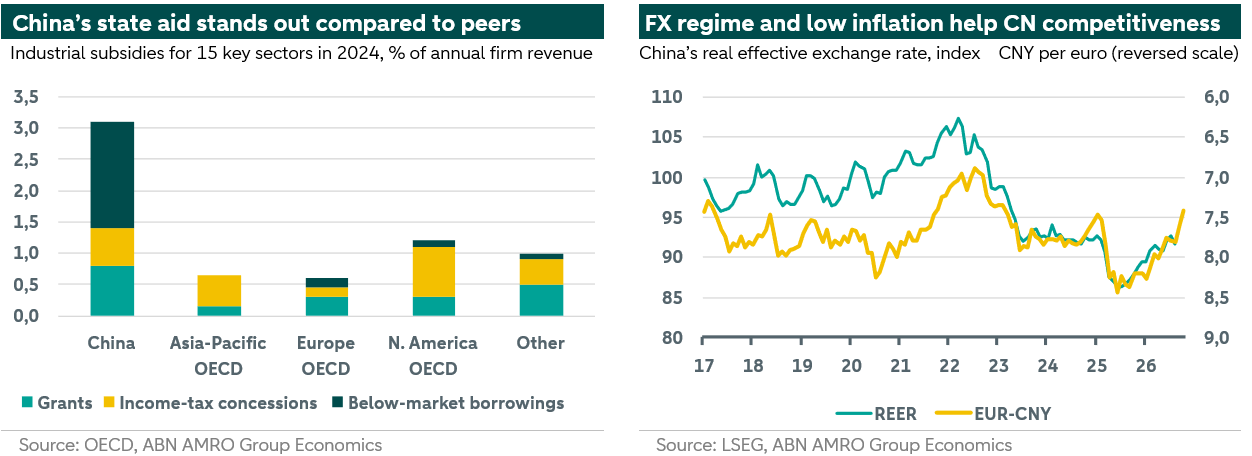
…impacting EU-China trade, with ‘clean energy’ car sector most eye-catching case
China’s rapid rise in high-tech manufacturing, its domestic overcapacity, and the resulting flooding of global markets with relatively cheap Chinese supply is having major trade repercussions, particularly for Europe (the US put high tariffs on sensitive imports from China such as EVs). Chinese exports to the EU have continued to grow over the past few years (see chart). By contrast, Chinese imports from the EU have come down since 2022; the contraction for Germany is significantly sharper than for the EU average, with vehicle imports being particularly hit (see below). This drop in China’s imports of European/German products also reflects China’s policy to reduce dependencies and switch to domestic supply. All in all, China’s goods trade surplus with the EU has risen sharply since 2021 and is projected to reach another record this year.
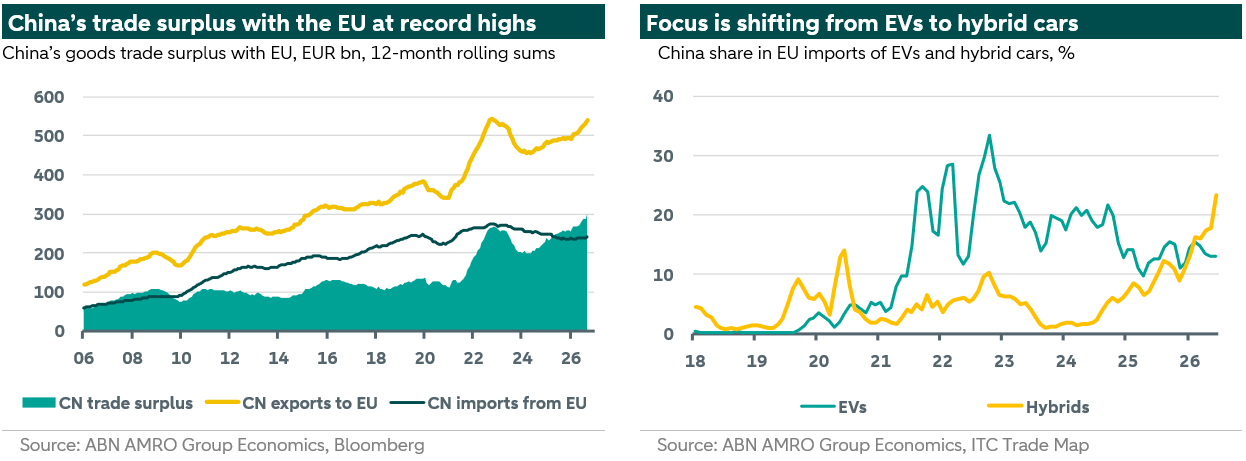
The most striking, and politically sensitive, example of the shift in China-EU trade patterns is visible in the European car sector, which faces a ‘double whammy’. The rapid rise of China as an exporter of ‘clean energy cars’ like EVs and hybrids – coupled with falling Chinese imports of European cars – have turned the traditional EU trade surplus in cars with China (led by Germany) into a deficit. China’s share in the EU’s imports of EVs has risen sharply in 2021-2023 (chart), although it has come down in recent years, with the EU introducing tariffs end-2024. Since 2023, China’s share in the EU imports of hybrid cars is rising sharply, which explains the recent change in Europe’s policy focus towards this segment (see below).
China Shock 2.0 is the Europe’s defining competitiveness challenge
What is the macroeconomic impact of China’s industrial rise on Europe? At its core, it is a story of weaker demand for European products. Chinese firms have gained market share at home, in Europe and in third-country markets, reducing demand for euro area exports and weighing on European production and investment. At the same time, cheaper Chinese imports have a disinflationary effect by lowering the prices of both consumer goods and intermediate inputs. At a time of above-target inflation, this provides marginal relief for consumers, but it also worsens the growing competitive pressure on European manufacturers.
The impact is increasingly visible in the euro area's growth mix, although the effects are unequal across the area (see below). Stronger Chinese competition weighs on export growth and makes European firms more reluctant to invest. The labour market effects have so far been more contained, but they are becoming visible in most exposed industries. Indeed, labour demand has decreased in past years in those manufacturing subsectors most exposed to Chinese competition (see ). Looking forward, we expect this to persist in 2027 and to lead to higher imports, weaker exports and investment, resulting in a negative contribution of net exports to GDP in the eurozone.
Importantly, the China Shock 2.0 did not occur in isolation. European manufacturers entered this period after successive shocks had already weakened their competitive position. First pandemic-related supply-chain disruptions constrained production globally, while the energy crisis in Europe subsequently pushed up input costs, particularly for energy-intensive manufacturers, most notably German chemicals. China gaining export market share then added a third challenge. Chinese manufacturers emerged increasingly competitive in higher-value industries at a time when European producers were still adjusting to higher costs and disrupted supply chains. The result has been a general erosion of European producers' relative competitive position rather than a standalone "China shock".
The triple whammy competitiveness shock with Germany at the centre
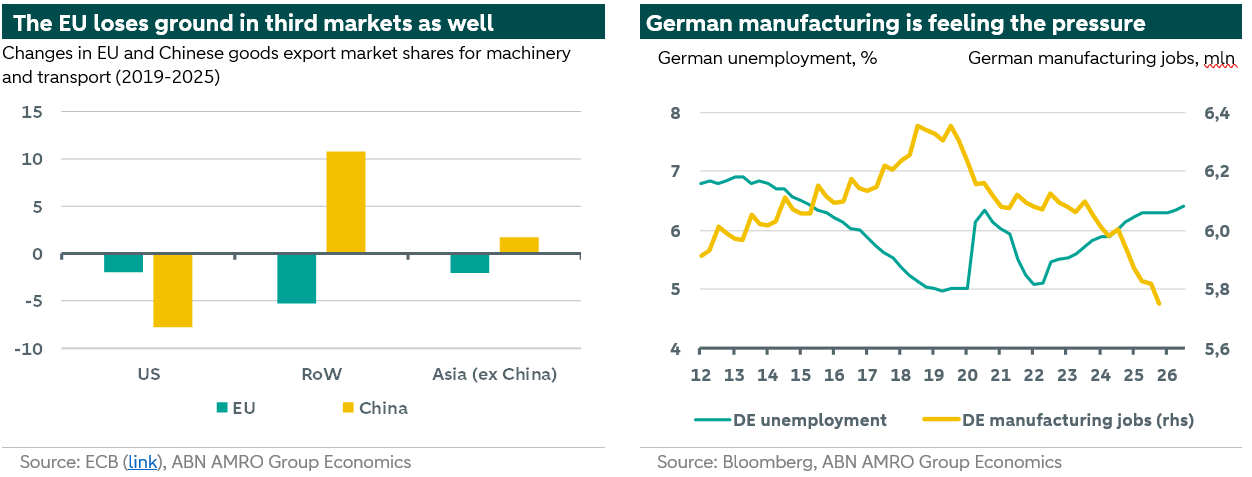
China Shock 2.0 reaches European producers through three channels: 1) falling European exports to China, driven by weak demand and import substitution; 2) stronger Chinese competition in third-country markets (outside the US); and 3) rising Chinese exports to Europe itself. These pressures fall most heavily on Germany, which previously enjoyed a comparative advantage in these markets, as well as on manufacturing suppliers such as Czechia and Hungary. To illustrate, Chinese vehicle and chemical exports to euro area increased by around 150% and 140%, respectively, between 2019 and 2024 (see ).
The relative weight of these channels, however, differs across industries. The German car sector is perhaps the clearest example of an industry exposed to all three. German car exports to China are declining on an annual basis for the past years, whereas a decade ago Germany profited from China as export market. Chinese rising exports to third markets and to the European market further add to the pressure on German carmakers. However, China Shock 2.0 extends beyond cars. The three channels mentioned are also at play in the broader machinery and capital goods industries, that traditionally formed part of Germany’s comparative advantage. For chemicals, the story is slightly different: rising Chinese imports into Europe and declining EU exports to China are the main channels of impact. Competition with China in third markets is a less straightforward case, not least because the US remains the key export market for German chemicals. US tariffs nevertheless add a separate source of uncertainty.
Europe’s China dependence remains a strategic risk in trade policy going forward
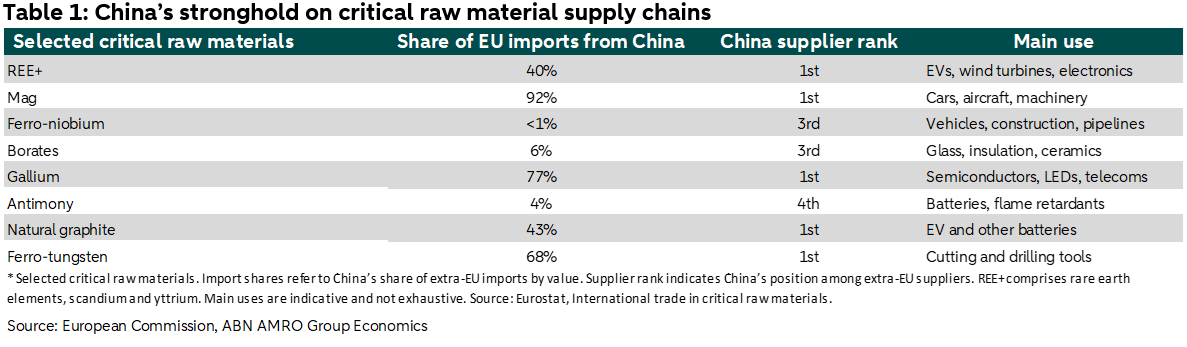
Europe’s exposure to China extends beyond export competition. China is deeply embedded in European supply chains as both a major production hub and supplier of critical raw materials (see and table 1 below), including those essential for the energy transition. This creates a strategic vulnerability: measures to protect European industry could raise input costs and disrupt supply chains, certainly in case of Chinese retaliation. These dependencies limit Europe’s room for manoeuvre, making de-risking and diversification more realistic than decoupling, particularly in the near term.
The EU is expanding its toolkit
The EU responded in various ways to rising trade imbalances with China and the large dependence on China for certain critical inputs. Without being exhaustive: on the trade imbalances front, the EU decided in late 2024 to implement tariffs of up to 45% (on top of the standard 10%) on imports of Chinese electric vehicles (EVs). China responded, amongst other things, with import tariffs on European brandy and pork and started a probe into large-engine European cars. In June 2026, the EU and China agreed on installing an October 2026 deadline for ‘tangible results’ in the rebalancing of EU trade and investment with China. Subsequent talks between Brussels and Beijing resulted in an agreement reached in early October to cap EU imports of Chinese hybrid cars (at 350000 vehicles per year, starting per 1 December 2026). Also, agreements were made on EU access to Chinese rare earth materials, and some tariff reductions. One week after this deal, European leaders (led by Germany and France) asked the Commission in a special summit to develop further tools to manage the impact from China Shock 2.0. This may include the deterrent of a potential ‘full blockage’ under specific circumstances. The Commission will also evaluate other trade data to see whether the approach used for hybrid cars could be followed in other sectors. The turn in policy stance of particularly Germany is remarkable and could be seen as an economic Zeitenwende. In 2024, Berlin opposed EU tariffs on Chinese EVs, as Germany prioritised the protection of its export and other interests related to China.
On the dependence front, Brussels embraced a “derisking” (not decoupling) strategy in 2023, aiming to reduce dependencies/risks around sensitive technologies (e.g. semiconductors/AI), green transition chains and critical raw materials. Part of this strategy was the adoption of the Anti-Coercion Instrument, which can be used when non-EU countries use economic pressure to influence political choices within the EU. In 2024, the Critical Raw Material Act was adopted, which stipulates that by 2030 no more than 65% of the EU’s annual consumption of strategic raw materials should be sourced from a single third country. Currently, the EU is working on a diversification instrument (Diversify EU) that is expected to be presented end-2026, which should further reduce strategic dependencies.
Will we see an EU-China trade war in 2027?
One of the questions surrounding our macroeconomic outlook for 2027 is whether we are heading towards a serious EU-China trade conflict. In our base case we do not expect EU-China trade tensions to escalate into a trade war. Yes, European language versus China has clearly toughened up, particularly in Berlin and Paris. Yes, the EU continues to expand its trade toolkit and to manage China-related risks. And yes, China has plenty of options to retaliate, if Beijing thinks Brussels is going too far (like it did last year versus the US).
However, the approach that Brussels is following so far is radically different to that initially followed by the current US administration. Last year, sky-high US import tariffs and tighter restrictions on tech (semiconductor) exports versus China were followed quickly by proportional Chinese retaliation in the form of similarly high counter-tariffs and rare earth export controls. The consequence was that the US had to backtrack quickly and comprehensively (see for instance ). By contrast, the EU and China keep talking in a seemingly much more constructive way. Further talks, for instance on China’s exchange rate regime, are scheduled in the coming months. It looks like Brussels is ‘testing the waters’ to find out which trade measures can still be accepted by Beijing without triggering severe retaliation, or even an all-out trade war, while sticking to a WTO framework. The recent hybrid car deal suggests common ground can still be found. This approach could perhaps be followed more often, with machinery, chemicals and furniture mentioned as potential sectors.
At the end of the day, what matters most for Brussels is that tailor-made trade measures like import caps and/or tariffs for certain sectors can take away some of the most urgent pressures for European industry, while keeping relations with a key trade partner like China orderly. This is especially important given the critical dependencies of European industry on certain raw materials. And what matters for China is that, although Beijing will keep defending its interests and may (threaten to) retaliate from time to time, there is probably not much appetite to enter into a serious trade conflict with the EU. After all, the EU has become China’s main western export destination, while relations with the US are still in a ‘fragile equilibrium’. To conclude, while there are downside risks, and we do incorporate trade skirmishes into our base case, we do not foresee a serious escalation that results in an all-out trade war.